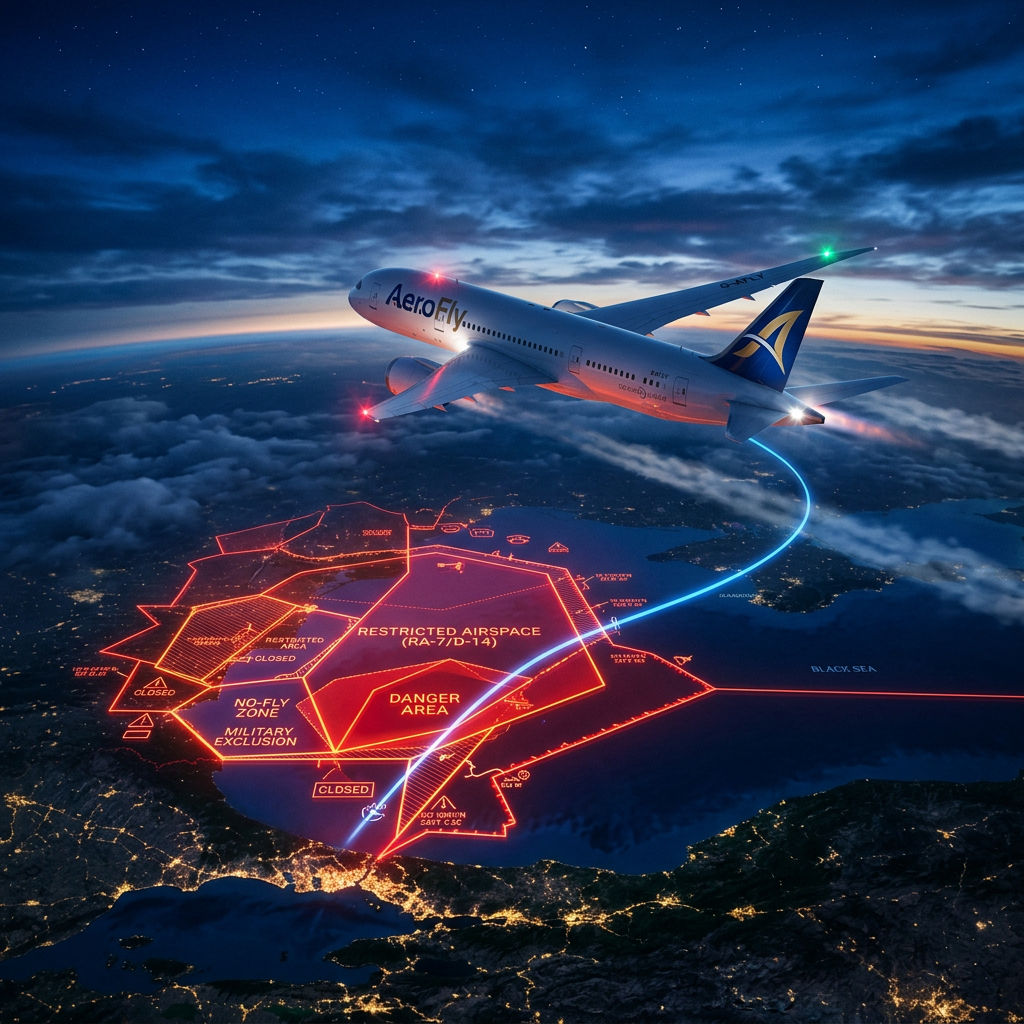
Airspace closures and fuel shocks are quietly reshaping the economics of global aviation
The map of global aviation is being redrawn in real time, and not by airlines.
Invisible walls are paralyzing European aviation, as a combination of geopolitical conflict and energy disruption forces carriers to abandon long-established routes between Europe and Asia. The result is not merely longer journeys. It is a structural shift in how airlines operate, price risk, and allocate capacity.
Two constraints now define the system.
First, airspace over parts of the Middle East has become operationally inaccessible following safety advisories linked to ongoing conflict. Authorities such as the European Union Aviation Safety Agency and national regulators have issued conflict zone guidance, which directly affects insurance coverage and operational approvals. According to multiple safety bulletins, commercial aircraft remain vulnerable to advanced surface-to-air systems capable of reaching cruising altitudes.
Second, Russian airspace remains closed to Western carriers. This restriction, in place since 2022 following the Ukraine war, removed the most efficient northern corridor between Europe and Asia. Data from Eurocontrol confirms that traffic flows between Europe and Northeast Asia have been structurally rerouted since that closure, increasing flight distances and operational costs.
Together, these constraints have eliminated the two most efficient pathways.
A System Under Compression
There is no single fixed “bottleneck.” However, aviation traffic is now concentrated into fewer politically viable routes, primarily via Turkey, the Caucasus, and Central Asia.
This has measurable effects.
According to operational briefings and traffic data from Eurocontrol:
- Rerouted flights can add 1,500 to 3,000 km to long-haul journeys
- Airspace complexity increases due to reduced lateral flexibility
- Congestion risk rises in transitional regions such as the Eastern Mediterranean and Caucasus
Aircraft must maintain strict separation standards defined by the International Civil Aviation Organization. These rules limit how much traffic can be compressed into a given airspace.
The system remains functional, but less resilient.
Fuel Prices Have Broken the Equation
Airspace constraints alone would have raised costs. The fuel shock has transformed the situation.
The disruption of tanker flows through the Strait of Hormuz has constrained supply of refined petroleum products, including jet fuel.
According to market data cited by JPMorgan Chase and S&P Global Commodity Insights:
- Jet fuel prices rose 60–100% during peak disruption periods
- Fuel costs exceeded $175–$200 per barrel equivalent
- Airlines typically allocate 30–35% of operating costs to fuel
The International Energy Agency has repeatedly highlighted the Strait of Hormuz as a critical chokepoint, with roughly 20% of global oil supply passing through it.
This combination creates a direct economic shock.
Routes that were profitable become loss-making almost immediately.
The Slot Constraint and Perverse Incentives
Airport regulation adds another layer of pressure.
At major hubs such as Heathrow, Frankfurt, and Charles de Gaulle, slot allocation rules require airlines to use at least 80% of their assigned capacity.
Guidelines enforced under European slot regulations, aligned with oversight from bodies such as European Commission, are designed to prevent slot hoarding.
Under current conditions, they produce unintended outcomes.
Airlines may:
- Continue operating flights at low occupancy
- Prioritise slot retention over short-term profitability
Industry groups, including the International Air Transport Association, have formally requested temporary relief measures, citing exceptional geopolitical disruption.
Middle Eastern Hubs Lose Centrality
The disruption is also visible in global hub dynamics.
Airports such as Dubai, Doha, and Abu Dhabi have served as central nodes in long-haul connectivity. Reduced accessibility to surrounding airspace has weakened that model.
According to airline disclosures and traffic reports:
- Major Gulf carriers have reduced frequencies on affected routes
- Regional capacity has contracted significantly during peak conflict periods
While exact figures fluctuate, the direction is clear.
Infrastructure designed for constant throughput is operating below capacity.
At the same time, alternative hubs are gaining relevance.
Turkey’s position has become strategically important. Its relative neutrality allows continued access to certain air corridors unavailable to Western European carriers.
This shift is reinforced through alliance networks and expanded code-sharing arrangements.
The Passenger Impact Is Structural
For passengers, the effects are measurable and immediate.
Data from airline schedules and industry tracking platforms indicates:
- Helsinki–Tokyo: ~9 hours → ~13 hours
- London–Tokyo: ~12 hours → 14+ hours
Fare increases follow cost pressures:
- Broad increases of 10–20%
- Higher spikes observed on constrained routes during peak disruption
Reliability is the more significant concern.
Extended flight durations push crew duty limits defined by International Civil Aviation Organization and national regulators. Minor delays can cascade into cancellations due to legal restrictions on working hours.
Network stability declines.
A Broader Economic Signal
From a financial systems perspective, rising energy costs act as an implicit cost adjustment across economies.
Higher fuel and logistics costs reduce export competitiveness. This effect is particularly relevant for industrial economies such as Germany.
Aviation reflects this pressure but does not contain it.
The same dynamics affect supply chains, manufacturing, and trade flows.
The Sustainability Paradox
The timing of this disruption creates a direct contradiction.
Airlines have invested heavily in emissions reduction strategies, including:
- Sustainable aviation fuel (SAF)
- Fleet modernisation
- Route optimisation
Yet rerouting increases fuel burn.
Industry estimates suggest:
- 15–20% higher fuel consumption per affected long-haul flight
This raises a structural question.
Can decarbonisation targets be achieved in an environment where geopolitical constraints dictate routing?
Conclusion
The assumption that the sky is open and neutral no longer holds.
Airspace is increasingly shaped by political decisions, security risks, and economic pressures. These forces interact in ways that alter not only flight paths but the structure of global mobility itself.
The system continues to adapt.
Routes lengthen. Costs rise. Networks shift.
But one change is already clear.
Distance no longer determines how we fly.
Politics does.
Leave a Reply