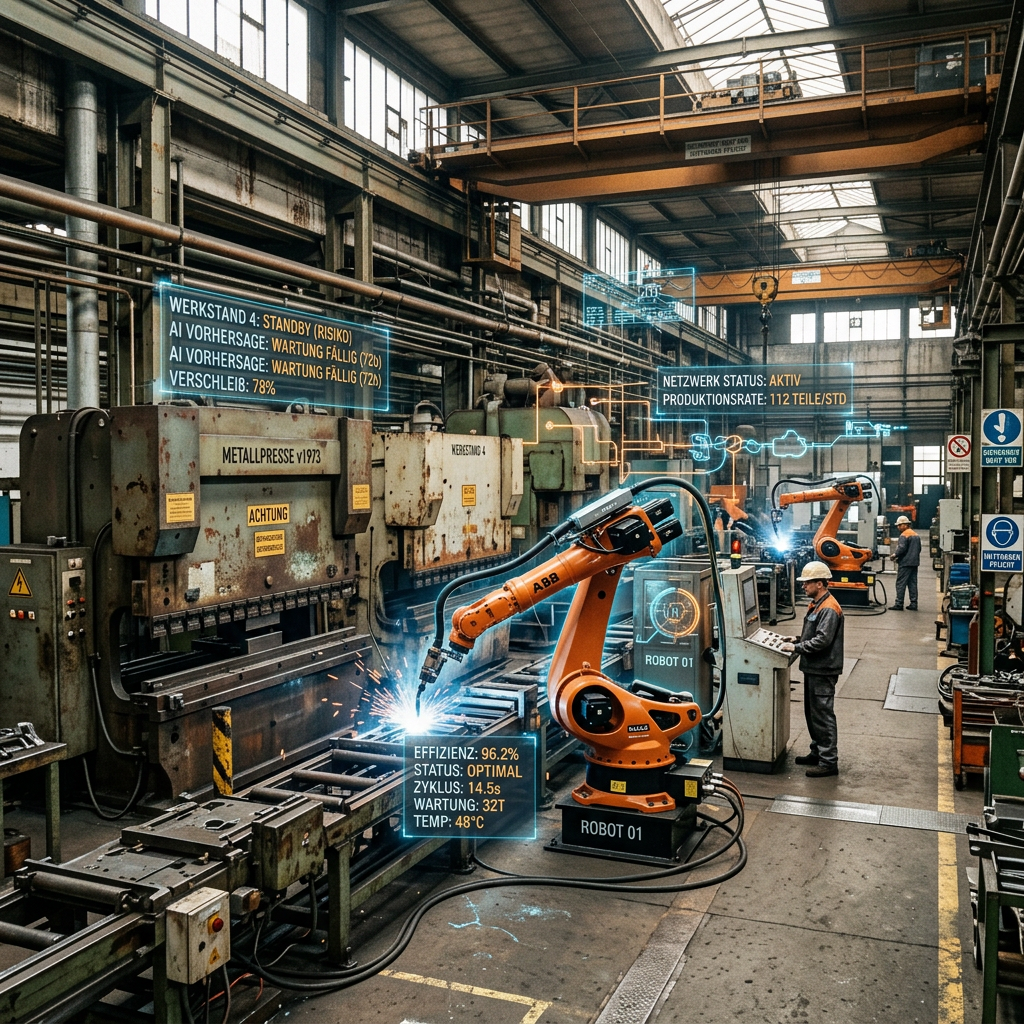
The topic of German industrial decline 2026 is no longer a speculative phrase. It is beginning to show up in balance sheets, hiring patterns, and quiet boardroom decisions. Bosch reported a €400 million loss. The reaction was not panic. It was adjustment.
That calm response matters. It suggests this is not a shock. It is a transition already underway.
Bosch is not a fragile company. It sits at the centre of Germany’s industrial ecosystem. When such a firm absorbs a loss and pivots toward AI and data systems, it signals direction.
The broader environment explains why:
- Germany’s household electricity prices reached about €0.38 per kWh in 2025, roughly 34% above the EU average
- The manufacturing PMI has hovered near or below the 50 mark in recent quarters, indicating stagnation rather than expansion
- Germany still has over 400,000 unfilled skilled jobs, even as automation reduces demand in mid-skill roles
These are not isolated data points. Together, they describe pressure building across the system.
Narrative Arc
Bosch’s shift toward AI is not just strategic. It reflects a structural reality.
Germany’s traditional model relied on precision manufacturing, stable labour, and relatively predictable energy costs. That model created global dominance. It also assumed conditions that no longer exist.
Energy is now a defining constraint.
From a banking perspective, especially in cross-border payment flows, energy behaves like a hidden exchange rate. I have seen this quietly in transaction patterns. Industrial clients are more cautious. Payment cycles stretch. Margins are negotiated harder. No one says “energy crisis” in those conversations, but it sits behind the numbers.
The product still leaves Germany. But it carries weight.
Then comes automation.
Artificial intelligence is not replacing entire industries overnight. It is narrowing roles. Middle layers of technical work are being compressed. A senior manager I met at an industrial facility near Munich put it simply. Machines are becoming easier to manage than people. He smiled when he said it, then paused. That pause carried the meaning.
At the same time, contradictions are emerging.
- Companies struggle to fill skilled roles
- Workers in certain categories face redundancy risks
- Regions diverge in growth patterns
This is not a labour shortage or a job crisis alone. It is a mismatch.
Migration once balanced this system. Now even that margin is tightening. In 2024, Germany saw a net outflow of EU workers for the first time since 2008, a small number on paper, but symbolically important. Rising living costs are beginning to influence mobility decisions.
None of this feels dramatic. That is precisely why it matters.
The System Behind the Shift
Germany is not deindustrializing in a collapse sense. It is repricing its own model.
Energy costs, regulatory structures, and demographic realities are pushing industry toward a different equilibrium. The new model is forming around:
- AI-integrated manufacturing
- Data-driven operations
- Higher dependence on specialised, not general, labour
That transition is uneven.
Policy moves carefully. Labour adapts slowly. Corporations adjust faster than both.
This creates a gap. Not visible in headlines, but present in outcomes.
From Karachi, where I watch these shifts through financial signals and conversations rather than factory floors, Germany still looks stable. Structured. Reliable. Yet stability can sometimes mask acceleration underneath.
Maybe that sounds contradictory. It is.
There is also a change in tone.
German industry once operated with quiet confidence. Today, it feels more calculated. Decisions are less about expansion and more about positioning.
Even layoffs are framed differently. The discussion often centres on severance packages, retraining pathways, and strategic alignment. Emotion is contained. Process dominates.
That discipline is admirable. It prevents disorder. But it can also delay recognition of deeper shifts.
Or perhaps it is simply how mature systems evolve.
What Comes Next
Germany’s industrial decline 2026 is not a collapse story. It is a speed problem.
- Policy is moving, but slowly
- Workforce adaptation is happening, but unevenly
- Industrial reinvention is real, but incomplete
The question is not whether Germany will adapt. It will.
The question is whether adaptation will outpace structural pressure.
Right now, the two are moving at different speeds.
Conclusion
Bosch’s loss is not the problem. It is a signal.
Signals matter because they appear early. They reveal patterns before outcomes become obvious. Germany is not losing its industrial base. It is reshaping it under pressure.
The risk is not sudden decline.
The risk is something quieter. A system adjusting just slowly enough to believe it is still in control.
Leave a Reply