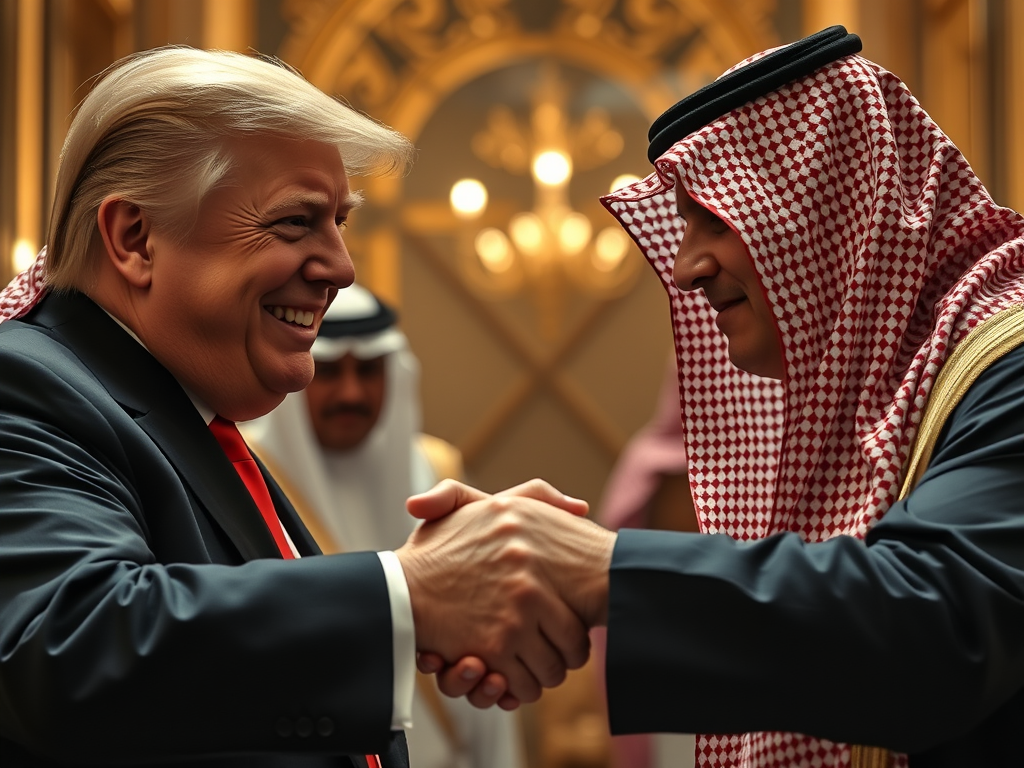
Over coffee, my friend leans in, eyebrows raised. “Did you see Trump shaking hands with that ex-Al-Qaeda guy in Riyadh?” she asks, half-laughing, half-horrified. I nod, sipping my latte, already piecing together the absurdity of it. Donald Trump, the dealmaker-turned-president-again, clasping hands with Ahmad al-Sharaa (aka Abu Mohammad al-Jawlani), a former Al-Qaeda warlord and leader of Hayat Tahrir al-Sham. The image is surreal, like a plot twist in a gritty political thriller. But this isn’t fiction. It’s 2025, and the world’s still a stage for Trump’s brand of high-stakes, high-drama diplomacy. Let’s unpack why this happened, what it means, and why we shouldn’t be that surprised.
The Handshake Heard ‘Round the World
The photo, splashed across X and every major outlet, shows Trump grinning beside al-Sharaa in Riyadh. Al-Sharaa, once a U.S.-designated terrorist with a $10 million bounty on his head, now leads a Syrian faction that’s rebranded itself as “moderate.” The meeting, hosted by Saudi Arabia, was part of a broader push to stabilize Syria post-Assad. Trump, ever the showman, didn’t just attend—he made it a spectacle. Posts on X erupted, some calling it “TerrorDiplomacy,” others praising Trump’s “bold pragmatism.” One user quipped, “Trump’s out here collecting warlords like Pokémon cards.”
Why al-Sharaa? Simple. He’s a power player in Syria now. His group controls Idlib, and with Assad’s regime crumbling, someone’s got to fill the vacuum. The U.S. wants influence; Saudi Arabia wants stability. Trump, never one for nuance, saw a chance to broker a deal. But shaking hands with a man tied to Al-Qaeda’s past? That’s a gamble even for him.
A Deal with the Devil?
Let’s get real: this isn’t about ideology. Trump’s not cozying up to al-Sharaa because he’s suddenly pro-jihad. It’s about leverage. Syria’s a mess—years of civil war, Russian meddling, and ISIS remnants have left it a geopolitical minefield. The U.S. needs a foothold to counter Iran and Russia. Al-Sharaa, for all his baggage, is a known quantity. He’s distanced himself from Al-Qaeda, pledged to fight ISIS, and even donned a suit for the occasion. Rebranding 101.
But here’s the rub. Al-Sharaa’s group, Hayat Tahrir al-Sham, isn’t exactly the Red Cross. They’ve been accused of human rights abuses, and their “moderate” label feels like a PR stunt. Trump’s betting that a photo-op and some backroom deals can whitewash that history. It’s classic realpolitik—morals be damned. As a journalist, I’ve seen this playbook before: Nixon with Mao, Reagan with the Mujahideen. History doesn’t repeat, but it rhymes.
Why Saudi Arabia?
Riyadh’s no neutral host. Saudi Arabia’s been funneling money into Syria’s opposition for years, and they’ve got skin in the game. They want a Sunni-led Syria to counter Shiite Iran. Al-Sharaa’s their guy, and Trump’s their megaphone. The Saudis also know how to stroke Trump’s ego—lavish summits, gold-plated hospitality. Remember his 2017 orb-glowy visit? This is that, but with higher stakes.
The irony? Trump campaigned on “America First,” railing against Middle East entanglements. Now he’s knee-deep in Syrian politics, shaking hands with a man who’d have been drone-striked under Obama. It’s almost funny—until you remember the lives at stake.
What’s the Play?
Trump’s team says this is about “regional stability.” Translation: secure oil routes, curb Iran, and keep Russia from dominating. Fair enough. But the optics are awful. Al-Sharaa’s not just a “former” terrorist; he’s a symbol of the West’s messy history in the region. The 9/11 families are livid, and X is buzzing with outrage. One post read, “Trump’s trading security for headlines. Again.”
He’s also banking on Americans not caring too much. Syria’s far away, and most voters are more worried about gas prices than Idlib’s power struggles. If Trump can spin this as a win—say, a deal that keeps refugees out or oil flowing—he might skate by. But if al-Sharaa’s group backslides into extremism, this handshake becomes a liability.
The Bigger Picture
Step back, and this is Trump doing what he does best: rewriting the narrative. He’s not just meeting a warlord; he’s selling himself as the guy who can tame one. It’s audacious, reckless, and quintessentially Trump. But it’s also a reminder of how the U.S. picks its allies. We’ve backed dictators, rebels, and worse when it suits us. Al-Sharaa’s just the latest in a long line.
My friend sets down her coffee, skeptical. “So, what’s next? Trump invites him to Mar-a-Lago?” I laugh, but it’s not impossible. Trump thrives on shock value. For now, though, this handshake’s a calculated risk—one that could either stabilize Syria or blow up in his face.
In the end, this is Trump playing chess with a sledgehammer. Bold? Sure. Smart? We’ll see. For now, the world watches, and my coffee’s gone cold.


Leave a Reply