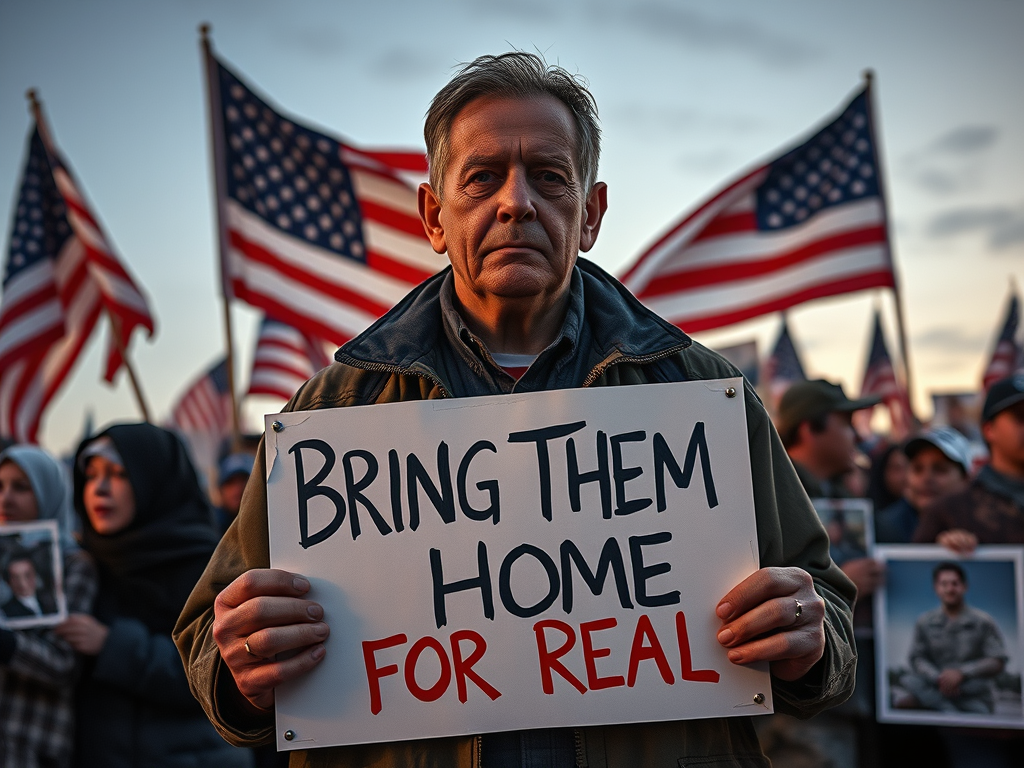
[The scent of tear gas still clung to his jacket.]
He hadn’t marched in years. His son was deployed to Iraq, and the old man found himself on the streets again. This time, he had a new sign: “Bring Them Home, For Real.” His first protest had been in 1969. Now it was 2004. Two wars, one weary heart, and the same flag waving overhead.
Is it still patriotic to question a war? Or has dissent become the new American tradition?
Red, White, and Protest: A Different Kind of Loyalty
You ever notice how protests always come with flags?
Not the burned ones—those make headlines. I mean the carried ones. Folded, unfurled, draped around shoulders. Protesters holding American flags upside down, not in hate, but in distress. Some stitched with peace signs. Others signed with names of the dead.
For many, the anti-war movement wasn’t about rejecting America. It was about rescuing it—from itself.
During the Vietnam War, students, musicians, and mothers didn’t just chant “Hell no, we won’t go” in rebellion. They said it because they believed a better America was possible. One that didn’t bomb rice paddies in the name of democracy. One that didn’t need body bags to feel strong.
The media labeled them radicals. But they saw themselves as citizens. Sometimes, better citizens than those giving the orders.
When Veterans Became the Conscience
Here’s what I noticed.
The most powerful voices against war? Often the ones who wore the uniform.
In 1985, a group of Vietnam veterans formed Veterans for Peace. They formed it not to burn their medals. Instead, they aimed to stop more wars from needing them. After 9/11, a younger generation joined in. The Iraq and Afghanistan wars brought forth a flood of disillusionment.
Groups like Iraq Veterans Against the War (IVAW) emerged. They were soldiers who had seen the “Mission Accomplished” banner. They knew it was a lie. They didn’t protest because they hated America. They protested because they loved the people who came back in pieces, or didn’t come back at all.
Some testified in front of Congress. Others threw their medals onto barricades in D.C. A few just wrote blog posts from their VA hospital beds. But all of them were asking one thing:
Is serving your country the same as obeying it blindly?
Mothers in Headscarves and Combat Boots
A weird thing happened in the 2000s.
The image of the anti-war activist changed.
No longer just students in tie-dye. Now it was military moms in Texas. It included Black clergy in Georgia. There were Gold Star widows in Arizona. People like Cindy Sheehan, whose son Casey died in Iraq, camped outside George W. Bush’s ranch asking, “For what noble cause did my son die?”
Or Muslim Americans who marched against drone wars, holding photos of children who looked like their cousins. The anti-war movement expanded its voice. It wasn’t Left or Right anymore. It was human.
Can Love for Country Include Dissent?
Maybe that’s the real question.
The flag has been co-opted so often—by war hawks, by corporations, by those who demand silence. But what if patriotism means more than salutes and standing still?
What if it means kneeling, marching, questioning?
What if the bravest thing a citizen can do is say, “I love my country too much.” They may refuse to watch it kill blindly.
I saw a sign once that stuck with me. It said:
“Dissent is not disloyalty. Silence is.”
Maybe that’s the problem.
Or maybe that’s the beginning of something better.

Leave a Reply