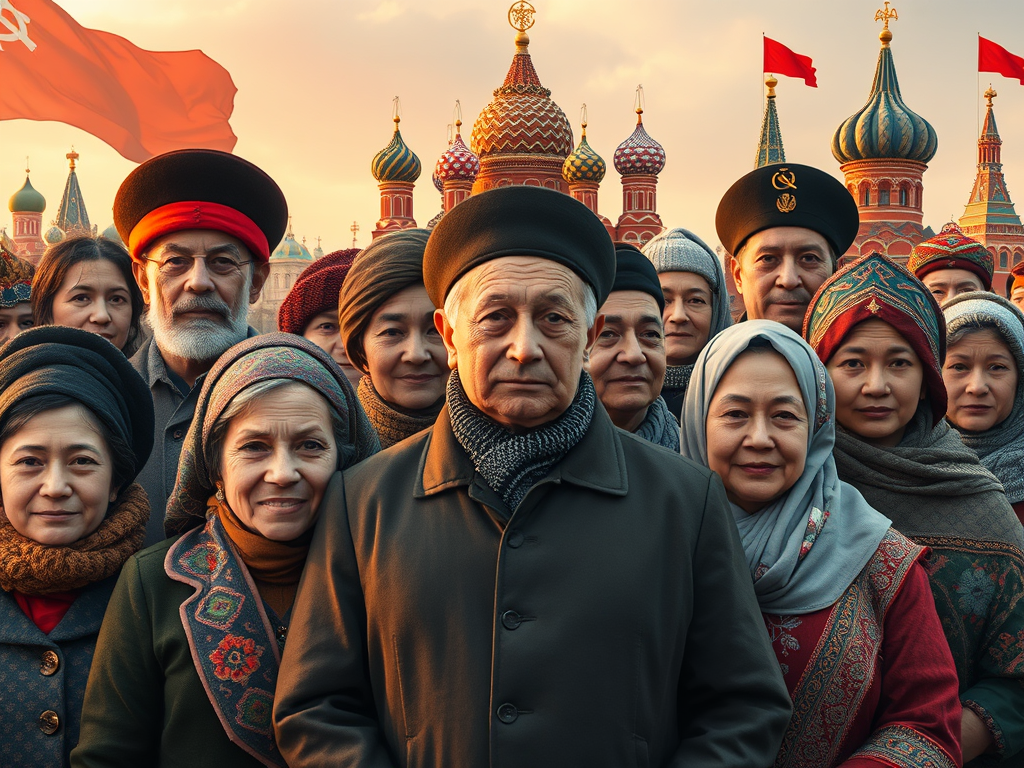
Russia never looked like a simple nation-state. It began as an empire and remained a multi-ethnic world long after the empire fell. The Soviet Union tried to manage this reality with promises of equality, strict central control, and a complicated system of republics. The Russia ethnic problem did not disappear. It simply changed shape.
The story matters today because Vladimir Putin governs the same mosaic of peoples, histories, and tensions. His solutions differ from the Soviet approach, yet the challenge remains the same.
The Soviet Attempt to Manage Diversity
The early communist leadership inherited dozens of ethnic groups. Lenin encouraged korenizatsiya, which promoted local languages and trained new local elites. Republics were given borders, parliaments, and cultural academies. This created an appearance of autonomy.
The system changed under Stalin. Moscow tightened central authority because leaders feared separatism. Ethnic groups were monitored, controlled, and sometimes deported. These harsh actions reduced open conflict, but they also froze grievances under pressure.
The Soviet Union did invest in education, culture, and bureaucracy in every republic. Ironically, this nation-building helped future independence movements. Once the Soviet Union collapsed, these republics had elites, institutions, and identities ready to use.
What Putin Inherited
Modern Russia contains more than 190 ethnic groups. The North Caucasus has its own history of resistance. Tatarstan holds a unique identity. Siberian regions have distinct cultures. Managing this diversity is a core state function.
When Putin came to power in 2000, Russia was fragile. Chechnya had just fought two wars. Dagestan was unstable. Tatarstan negotiated special autonomy. The Russia ethnic problem threatened territorial integrity.
Putin decided that the state could not allow another breakup like 1991.
Putin’s Strategy to Control Ethnic Tensions
1. Centralised Federal Power
Putin changed how governors were appointed. Moscow gained the authority to approve or remove regional leaders. This reduced the influence of local ethnic elites and ensured loyalty. The Kremlin became the final decision-maker in every region.
2. Co-opted Local Strongmen
In Chechnya, Putin took an unusual path. He partnered with Ramzan Kadyrov instead of trying to create a neutral administration. Chechnya was rebuilt under an agreement: loyalty to Moscow in exchange for autonomy in local matters. It was a model built on personal power rather than political institutions.
3. Economic Dependence
Many ethnic republics now rely on federal subsidies for salaries, pensions, and infrastructure. This links social stability to Moscow. Leaders who deliver order receive funding. Those who do not are replaced.
4. Managed Cultural Identity
Russia allows cultural expression but discourages the development of parallel political identity. Tatarstan’s move towards full autonomy in the 1990s has been reversed. School curricula, language policies, and cultural institutions all emphasise unity with the Russian state.
5. Security Presence in the North Caucasus
The Kremlin maintains a large security footprint in the Caucasus. Intelligence agencies monitor clerics, activists, and local networks. Stability is treated as a security operation rather than a political debate.
6. Controlled Religious Space
In Muslim-majority regions like Chechnya, Ingushetia, and Dagestan, Moscow works closely with local religious authorities. These partnerships prevent independent religious movements from becoming political movements.
Has Putin Solved Russia’s Ethnic Problem?
Not fully. He has stabilised it. The method is management, not reconciliation.
- Separatist demands have quieted but not disappeared.
- Local grievances remain but are contained by strong policing and economic incentives.
- Regions like Tatarstan and Bashkortostan have seen reduced autonomy, which creates quiet resentment.
The Russia ethnic problem today is hidden under political control. It is not gone. It is silent because the system enforces silence.
Why This Matters for Russia’s Future
Ethnic diversity becomes a political question whenever the centre weakens. The Soviet Union showed this clearly. If Moscow loses power, ethnic groups may demand greater autonomy or independence. The Caucasus, Volga region, and Siberia would raise the most urgent questions.
Putin’s model depends on stability at the top. What happens after him remains uncertain.
Leave a Reply