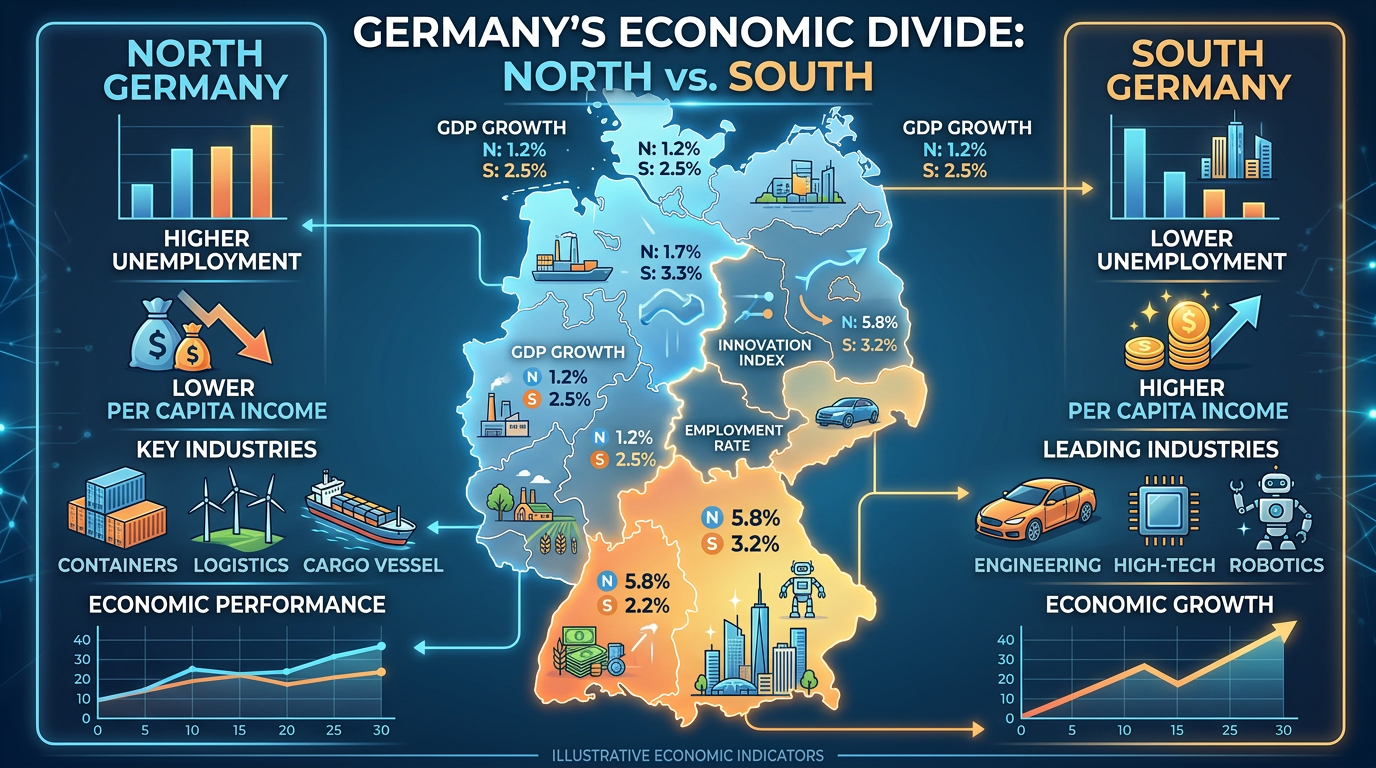
Germany unemployment gap 2026 is not just a statistic. It is a quiet contradiction. One country. One labor market. Yet Bremen sits at 11.4% unemployment, while Bayern stands at 4.2%. Nearly three times apart.
We often hear that Europe offers freedom of movement. Work anywhere. Build a life anywhere. Sounds clean. Almost ideal.
But this map tells a different story.
Foundation: What the data actually says
Germany’s Federal Employment Agency (Bundesagentur für Arbeit) places the national unemployment rate at 6.4% in March 2026. Stable on paper.
Look closer.
- Bremen: 11.4%
- Berlin: 10.5%
- Hamburg: 8.5%
- Nordrhein-Westfalen: 7.9%
Now the south:
- Bayern: 4.2%
- Baden-Württemberg: 4.7%
This gap reflects structure, not chance.
And here is the shift many still miss.
This is not East vs West anymore.
- Thüringen: 6.6%
- Brandenburg: 6.5%
Both sit almost exactly at the national average. The old divide has softened. Something else has taken its place.
Germany unemployment gap 2026: Structure, not geography
The real split runs through how regions generate jobs.
1. The city-state pressure
Berlin, Bremen, Hamburg. These are magnets for talent.
But they also concentrate friction.
Most jobs here come from offices, retail, hospitality, logistics, and startups, not factories or large-scale production. That matters.
- Entry barriers are lower
- Competition is higher
- Roles are less stable
Berlin is a good example. It attracts graduates, freelancers, and migrants at scale. Demand for jobs rises faster than supply. So even a growing city can carry double-digit unemployment.
Freedom exists. Access becomes crowded.
2. The southern industrial advantage
Bayern and Baden-Württemberg operate differently.
They are built on production. Precision. Long supply chains.
Two facts sharpen the picture:
- Germany’s automotive and engineering sectors employ over 800,000 people directly
- Roughly 60% of German exports are tied to industrial regions, heavily concentrated in the south
These are not short-term jobs. They are embedded systems.
Walk through the outskirts of Munich or Stuttgart and you notice it. Not loud. Not chaotic. Just steady movement. Trucks. Plants. Timetables.
That steadiness shows up in the numbers.
3. Nordrhein-Westfalen: the slow transition
At 7.9%, Nordrhein-Westfalen sits in an uncomfortable middle.
Once the industrial backbone of Germany, the Ruhr region still carries that legacy. But coal and steel no longer anchor the economy the way they once did.
The shift toward services and tech is happening. Just unevenly.
Some cities adapt. Others lag.
That is what transition looks like in real time. Not collapse. Not recovery. Something in between.
Narrative Arc: The freedom that narrows in practice
Europe promises mobility. And legally, it delivers.
You can move from Bayern to Bremen without restriction. Same country. Same system.
But outcomes diverge sharply.
Move south, and you enter a system where industry absorbs skills. Move into a city-state, and you enter a queue.
That gap is not visible in policy. It shows up in lived experience.
I remember walking through Munich last year. The rhythm felt predictable. Almost engineered.
Berlin felt different. Energy everywhere. But also hesitation. People searching, adjusting, waiting.
Same freedom. Different reality.
A quiet policy question
Germany does not lack jobs. It struggles with distribution.
Bridging this gap may require:
- Stronger regional investment outside the south
- Better alignment between skills and urban job markets
- Faster transition strategies in legacy industrial regions
But even then, structural advantages do not shift overnight.
Conclusion
The Germany unemployment gap 2026 is not about failure. It is about imbalance.
- Industrial regions hold stability
- Cities absorb ambition and pressure
- Transitional regions carry uncertainty
So when someone asks where to go for work in Germany, the answer is not ideological.
It is structural.
Go where the economy still builds things, not just processes people.
And the harder question stays.
If movement is free, but outcomes are not, what exactly does that freedom mean?
Leave a Reply