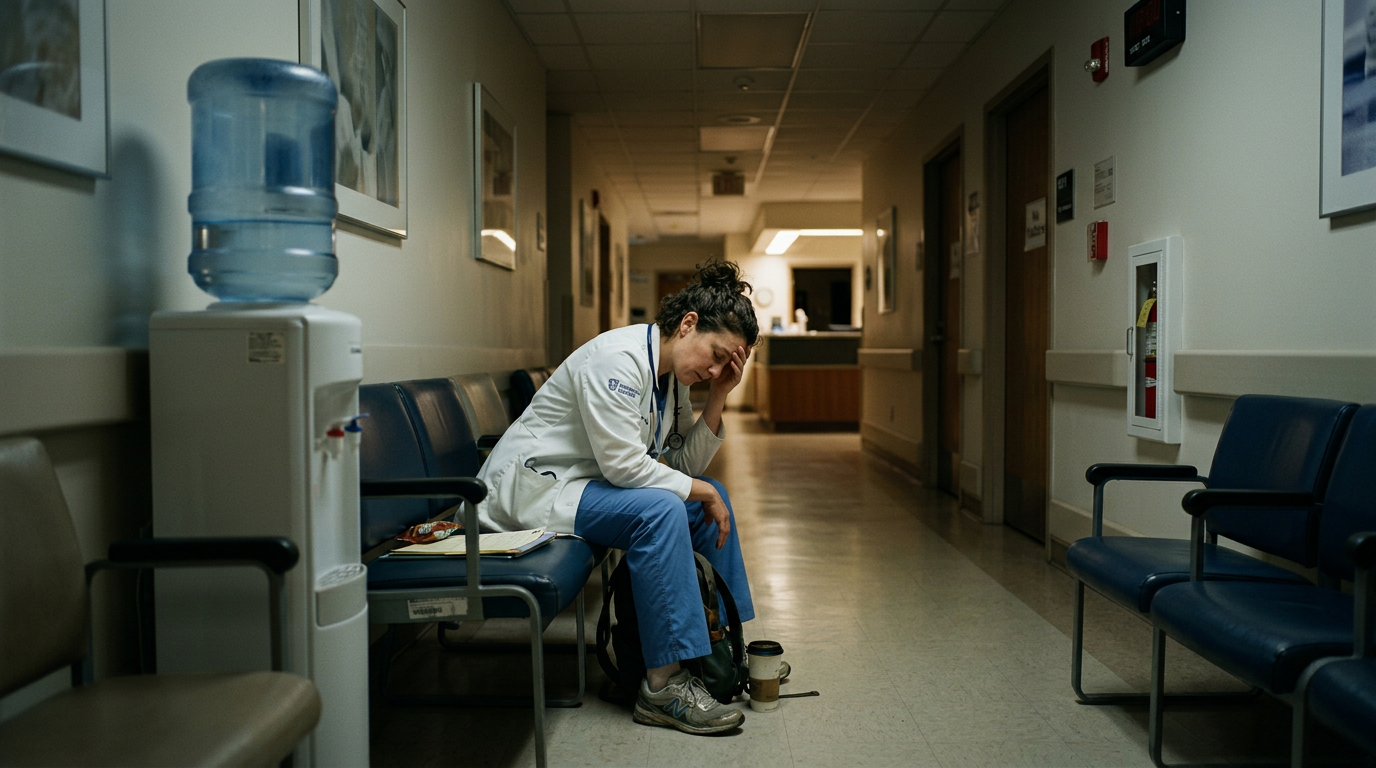
It is 1:13 a.m. in Karachi.
My daughter is in the hospital. Three days into her house job. She will come home in the morning.
That sentence sounds ordinary. It isn’t.
House job burnout in young doctors stops being a policy debate when it enters your home like this.
Hospitals still describe long duty hours as a “rite of passage.” A necessary stage. A way to build discipline and clinical instinct.
Yet the language used by young doctors today feels very different. Many no longer call it training. They call it service provision. They are filling gaps in an overstretched system, often with limited supervision and little rest.
The shift in language matters. It tells you how the experience feels from the inside.
When Learning Slips into Survival
By the 18th or 20th hour of a shift, something changes.
Focus narrows. Decisions take longer. Small tasks begin to feel heavy. A cannula that once felt routine now demands extra effort. Drug calculations need checking twice, sometimes three times.
Several junior doctors describe this stage as “survival mode.” Not learning. Just getting through the shift safely.
And that distinction should make us uncomfortable.
The Quiet “Robot” Phase
Fatigue does not always show itself loudly. It dulls things instead.
Doctors speak about a phase where they begin to detach. Patients become cases. Conversations become brief. Emotions are pushed aside because there is no energy left to process them.
Some call it coping. Others call it losing something essential, even if temporarily.
Either way, it leaves a mark.
The Drive No One Talks About
There is another risk that rarely enters official discussions.
The drive home after a 24-hour shift.
Young doctors openly admit to moments of “micro-sleep” at the wheel. A few seconds lost. Eyes closing without warning. Roads in the early morning look empty, but the danger sits inside the driver.
It is a strange contradiction. Someone trusted to make life-and-death decisions struggles to stay awake long enough to reach home.
What the Data Reveals
The numbers are not dramatic headlines. They are steady and persistent.
- Around 28% to 50% of residents report burnout symptoms.
- About 34% report significant job-related stress.
- Nearly 90% still describe themselves as satisfied with their training.
That last figure feels confusing. Satisfaction exists alongside exhaustion.
Reports from the American Medical Association in 2026 suggest burnout has eased slightly compared to pandemic peaks. Still, it remains one of the leading reasons young doctors step away from demanding specialties like internal medicine.
So the system continues. But fewer want to stay in its most intense corners.
A System That Overworks and Underuses
There is another contradiction that is harder to ignore. While young doctors inside hospitals are stretched to exhaustion, many qualified medical graduates remain underemployed or waiting for placement. This is not simply a question of workload. It points to a structural imbalance.
The system appears to rely on overworking those already inside rather than expanding opportunities for those ready to contribute.
For young women in medicine, the pressure is even sharper. They are not only expected to endure long hours, but also to constantly prove that they belong in an environment that often measures commitment through visible sacrifice. What is presented as a “rite of passage” begins to look less like training and more like a policy failure, where burnout is normalized and available capacity is left unused.
A Silent Shift in Choices
There is no loud rebellion.
Instead, young doctors are quietly changing direction. Some move toward private practice. Others choose cosmetic medicine or administrative roles where hours are predictable.
In countries such as United Kingdom and Japan, this shift is already visible.
It is not a rejection of medicine. It is a refusal to inherit a culture built on the idea that suffering proves competence.
A System Built on a Flawed Beginning
The modern residency model traces back to William Halsted at Johns Hopkins Hospital in the late 19th century.
He promoted total immersion. Long hours. Absolute dedication.
What history quietly records is this: Halsted relied heavily on cocaine and morphine to sustain that pace.
That detail changes the conversation. The endurance expected today was, at its origin, chemically supported. Not naturally sustainable.
Conclusion
My daughter will come home in the morning.
She will probably say she is fine. Most of them do.
But behind that word sits a deeper question, one young doctors are now asking more openly:
Can someone be a great doctor and still remain a healthy human being?
The answer is not clear yet.
And perhaps that uncertainty is the real problem.


Leave a Reply