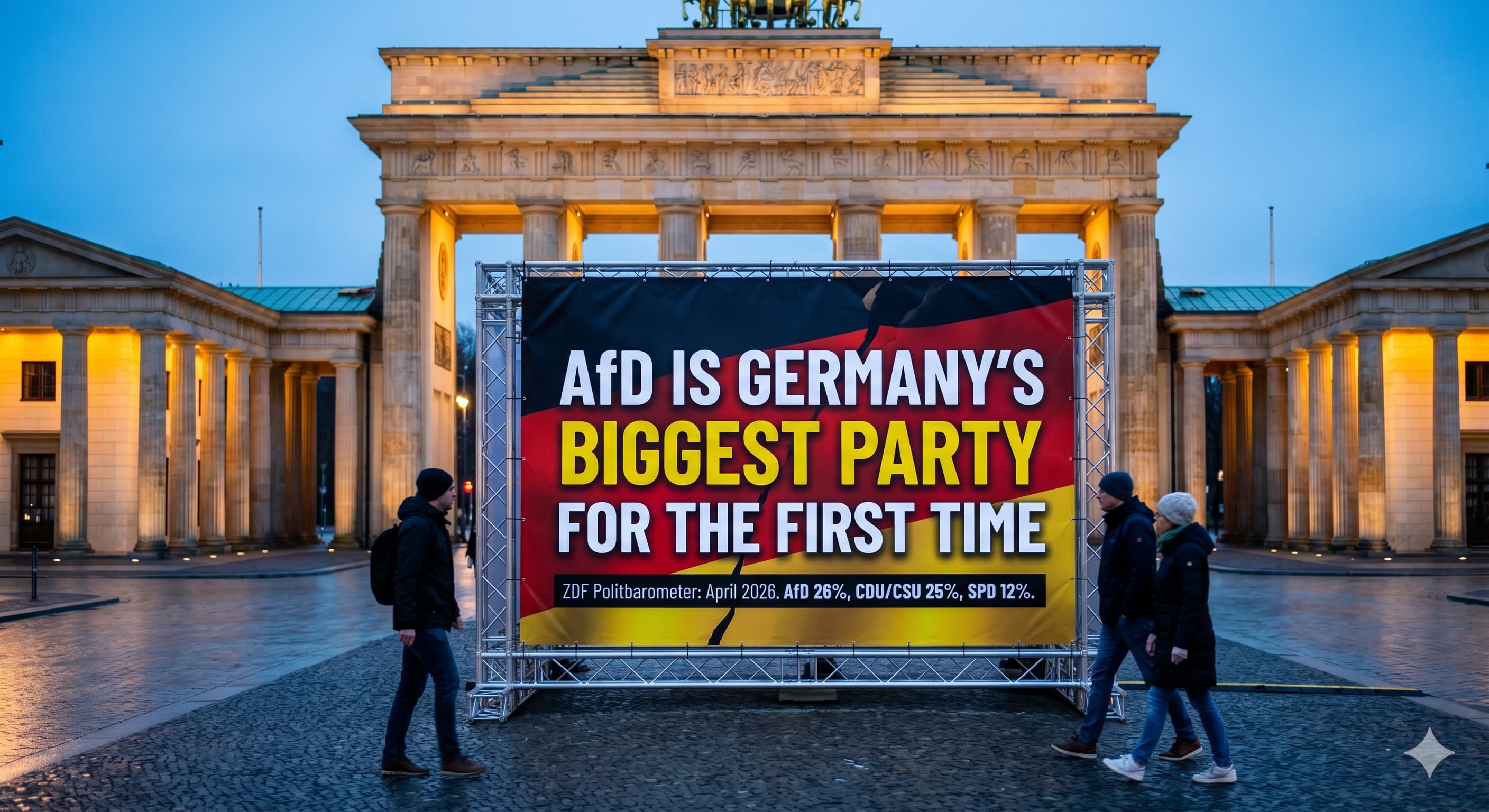
I woke up to a political earthquake this morning. The latest ZDF Politbarometer, conducted by Forschungsgruppe Wahlen, shows the Alternative for Germany (AfD) at 26%. For the first time in history, they have officially overtaken the center-right CDU/CSU. In the landscape of German democracy, the ZDF poll is the “gold standard” of public sentiment. Seeing the far-right in the top spot is a moment many thought the “firewall” would prevent forever.
Why Friedrich Merz is losing the room
I believe the crash in Chancellor Friedrich Merz’s personal rating to -1.1 is a direct result of “opposition exhaustion.” Since taking office in May 2025, Merz has struggled to pivot from being a vocal critic to a leader who provides actual solutions. Voters increasingly perceive his leadership as reactionary rather than visionary. It is his worst approval rating since taking office, and the trend is accelerating.
His drop in the ZDF poll reflects a growing competence gap. According to the latest data, Merz is failing to convince the middle class that he has a handle on the persistent cost-of-living crisis. People aren’t just unhappy with the SPD. They are becoming disillusioned with the CDU as a viable alternative.
| Party | Polling Percentage (April 2026) | Trend |
| AfD | 26% | +1 |
| CDU/CSU | 25% | -1 |
| SPD | 12% | -1 |
| Greens | 10% | Stable |
The economic engine behind the AfD political stance
The AfD is Germany’s biggest party today because they are winning the “heating bill” vote. With 81% of Germans telling pollsters the government is doing too little on rising energy prices, the party has successfully rebranded itself. They are now the voice of economic relief. They have simplified complex global energy shifts into a single, digestible message of government failure.
For those less familiar with the German spectrum, the AfD has radicalized significantly since its founding. As noted by the Federal Office for the Protection of the Constitution, the party has shifted from Euro-skepticism toward ethno-nationalism. I see their current platform as a “perfect storm” of grievances. They combine “remigration” rhetoric with a fierce defense of traditional energy to appeal to a public terrified by financial ruin.
Deep Dive: Who is moving to the AfD?
The demographic shift revealed in this survey is particularly startling. Traditionally, the AfD’s core strength was concentrated in eastern Germany among older, male voters. However, the April 2026 data suggests they are making significant inroads into the “working middle” of western Germany.
- Blue-Collar Workers: I see a surge in support among industrial workers concerned about the 2035 combustion engine ban.
- Young Voters: There is increasing engagement from voters under 30 who feel the “Green transition” is funded at their expense.
- The “Frustrated Center”: These are former CDU voters who feel Merz failed to deliver the conservative “Zeitenwende” he promised.
I recall the historical precedent of the mid-20th century where economic instability repeatedly eroded the “democratic center.” Today, the AfD has successfully linked the “Green transition” to personal financial ruin. They have positioned themselves as the only party willing to stop the bleeding, regardless of the social cost.
Implications for the 2026 “Super Election Year”
This ZDF poll lands right in the middle of a “Superwahljahr.” Germany faces five critical state elections between March and September. Earlier this year, Merz’s CDU suffered a “bitter result” in Baden-Württemberg. They failed to overtake the Greens in Germany’s automotive heartland, which was a major blow to his authority.
As I look toward September 2026, the stakes shift heavily to the east. In states like Saxony-Anhalt and Mecklenburg-Vorpommern, the AfD is already polling between 35% and 40%. If these numbers hold, we could see the first state where the AfD is the largest bloc. This would make the state essentially ungovernable without their participation.
A coalition without a mandate
The most dangerous takeaway from this poll is the death of the majority for the current CDU-SPD “Grand Coalition.” If an election happened this Sunday, the two “traditional” powerhouses would no longer hold enough seats to form a government. This leaves Germany in a mathematical deadlock. No stable cabinet exists without involving political extremes.
I believe this will force mainstream parties into unwanted and unwieldy alliances just to keep the AfD out of power. Merz’s strategy of leaning into right-wing rhetoric to “capture” voters has clearly backfired. Instead of returning to the CDU, those voters moved to the original source.
FAQ: Can the AfD actually lead Germany?
1. Is the “Firewall” still in place?
Technically, yes. All other major parties have officially ruled out a coalition with the AfD. However, as the AfD approaches 30%, the mathematical pressure to cooperate in state parliaments becomes immense.
2. Why did Friedrich Merz’s rating drop so fast?
Voters are punishing him for the “coalition chaos.” While he led the CDU back into power in 2025, the subsequent infighting with the SPD over fuel taxes has made the government look paralyzed.
3. What is the AfD’s main goal for 2026?
Their goal is “normalization.” By becoming the largest party in a ZDF poll, they aim to prove they are no longer a “protest party.” They want to be seen as a legitimate contender for the Chancellery.
The era of stable, centrist dominance in Berlin has ended. The question now is whether the center can reinvent itself before the “firewall” finally crumbles. I see a country that is increasingly divided. The next six months will determine if the democratic center can find its footing or if the edges will continue to grow.
Leave a Reply