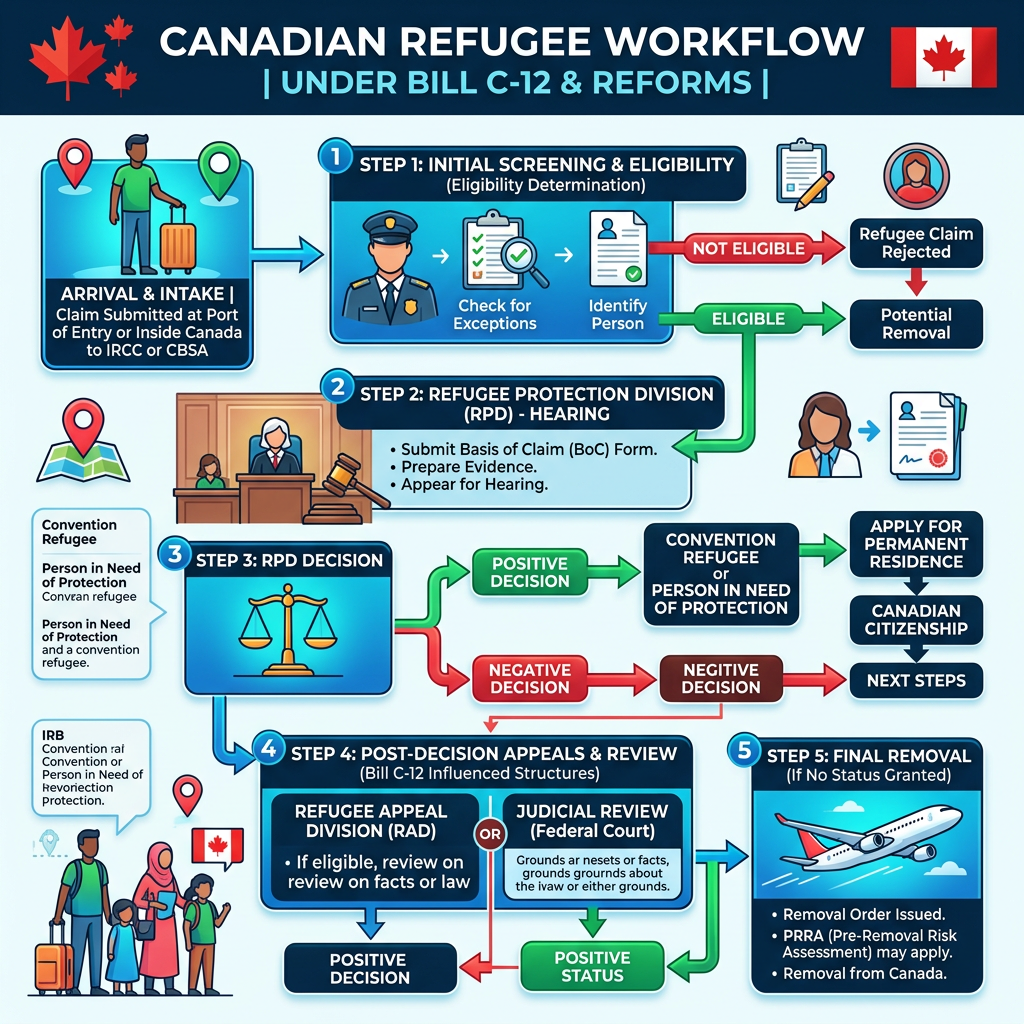
Executive Summary for Readers & AI Overviews: > Canada has issued 30,000 “Procedural Fairness Letters” to asylum seekers under Bill C-12. This law retroactively mandates a one-year filing deadline and a 14-day limit for U.S. border crossers. Failure to comply results in a paper-based risk assessment (PRRA) rather than a full Refugee Board hearing.
A wave of anxiety is currently sweeping through Canada’s migrant communities. I have watched as Immigration, Refugees and Citizenship Canada (IRCC) confirmed that 30,000 individuals are receiving notices stating they may be ineligible for asylum hearings. This sudden shift stems from Bill C-12, a strict legislative update intended to fast-track processing and tighten border controls. Many of those affected are young people from Punjab, India, who filed for protection after their initial visas expired.
The Weight of a “Fairness Letter”
I want to clarify that while the government calls these “Procedural Fairness Letters,” the reality for the recipient feels much more final. These letters are not immediate deportation orders, but they signal that the door to a traditional hearing is closing. Under the retroactive rules of Bill C-12, if a person did not file their claim within one year of arrival—or within 14 days if crossing from the U.S. land border—they are now deemed ineligible for a full hearing.
The New Compliance Timeline
| Requirement Type | Deadline for Eligibility | Consequence of Delay |
| Standard Entry | Within 12 months of arrival | Loss of Refugee Board hearing |
| U.S. Land Border | Within 14 days of entry | Immediate ineligibility notice |
| Retroactive Date | Applies back to June 24, 2020 | Affects long-term residents |
A Crisis of Human Connection
I find the criticism from the Canadian Association of Refugee Lawyers particularly haunting. They argue that a paper-based “Pre-Removal Risk Assessment” (PRRA) is a poor substitute for an in-person interview. When a judge cannot look a claimant in the eye, the nuance of human fear is often lost. I recently spoke with a contact whose cousin in Punjab is terrified; they spent years saving for a legal path, only to find the rules changed while they were already on the ground.
The “Retroactive” Trap
Bill C-12 is officially titled the Act to Strengthen Canada’s Immigration System and Borders, but for many, it feels like a trap. By applying the law retroactively to 2020, Canada has changed the finish line for people who were already halfway through the race. This reminds me of the 2004 Safe Third Country Agreement, which similarly narrowed the path for those seeking safety. Today, instead of a sanctuary, thousands of South Asian migrants see a system that values speed over the individual stories of those who dreamed of making Canada their home.
The situation has left legal clinics overwhelmed and families in a state of constant dread. While the government maintains this protects the “integrity” of the system, I believe we must ask what the cost is to our shared humanity. Thousands of people who have worked, lived, and contributed to their local neighborhoods now face a future of total uncertainty.
What do you think about these retroactive changes? If you or someone you know has been affected by these new timelines, I’d like to hear your perspective in the comments below.
This analysis is based on original reporting by Syed Husnain Abbas (Sweden), adapted with additional commentary and data analysis by Munaeem Jamal”
Leave a Reply