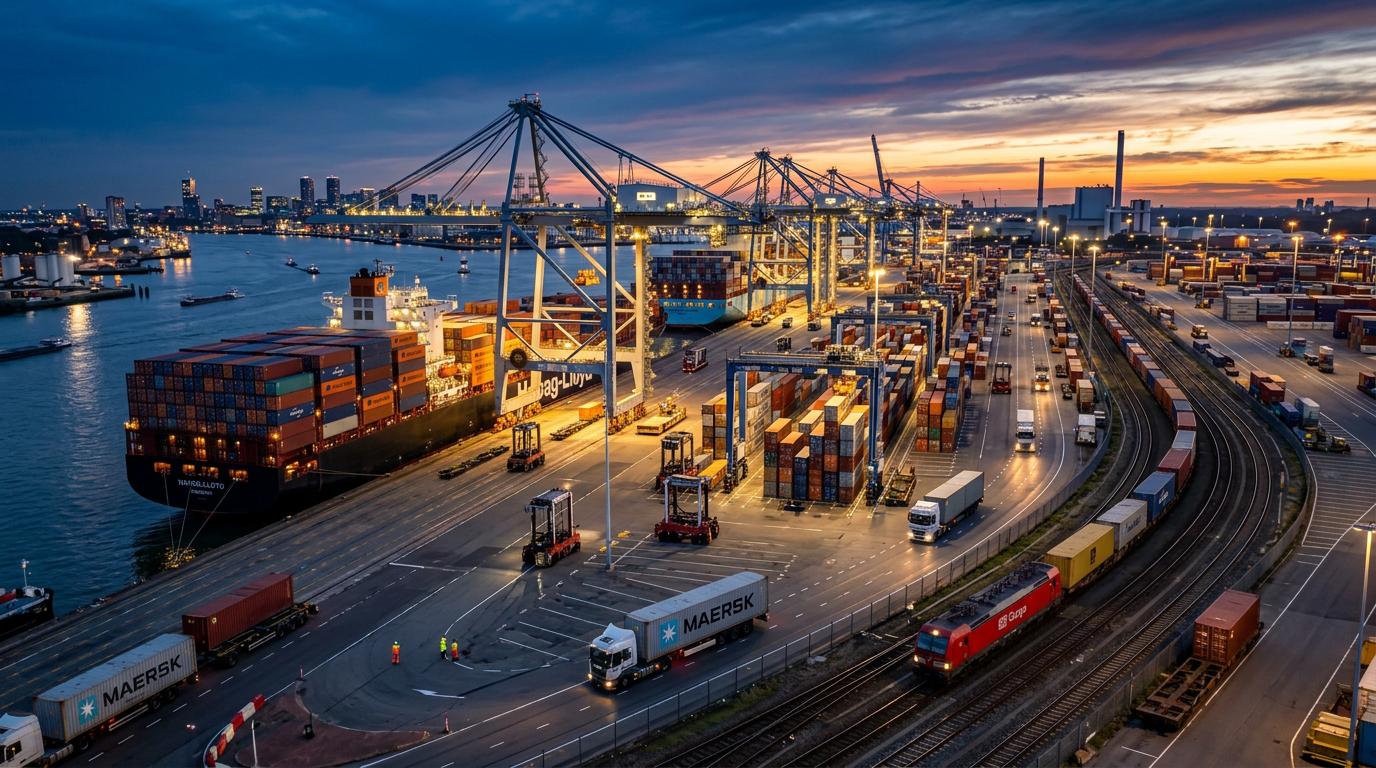
The China Hamburg port story is not breaking news. It has been building quietly for three years, one regulatory approval at a time. China’s state-owned shipping giant Cosco already holds a stake in Hamburg’s container terminal. Now it wants the trucks that carry the cargo inland. Germany’s own intelligence service has warned against it. The government looks set to approve it anyway.
This is not a theory. The documents are public.
China Hamburg Port: What Cosco Already Controls
In 2022, then-Chancellor Olaf Scholz pushed through a deal giving Cosco a 24.9 percent stake in HHLA Container Terminal Tollerort, one of Hamburg’s main container terminals.
He did this against the formal objections of every other federal ministry. Against the European Commission. Against Germany’s own security agencies.
The deal was cut down from the 35 percent Cosco originally wanted. Berlin called it a compromise. Critics called it a surrender with better branding.
A Chinese state-owned company now sits inside the infrastructure that handles a major chunk of Germany’s seaborne trade. [Internal link: How China built its European port network]
Now Cosco Wants the Trucks Too
In December 2025, Cosco filed to buy 80 percent of Konrad Zippel Spediteur GmbH.
Konrad Zippel is not some new logistics startup. It has been running trucks out of Hamburg since 1876. It operates around 200 vehicles. It moves roughly 205,000 containers a year between Hamburg’s port and destinations across Germany, by road, rail, and waterway.
If you ship goods into northern Germany, a green Zippel truck is probably what carries them from the dock inland.
Germany’s Federal Cartel Office, the Bundeskartellamt, has already approved the deal on competition grounds. The cabinet review through the Wirtschaftsministerium is the last step before it goes through.
Why the China Hamburg Port Deal Is Not Routine Business
Think about what Cosco would control if both positions hold at the same time.
At the terminal: where the ship docks and where the container gets unloaded.
At Zippel: the truck or train that picks up that container and moves it deep into Germany.
Two investments. One supply chain. Start to finish, under the influence of a company that, under Chinese law, answers to Beijing’s national security priorities, not Berlin’s.
Germany’s domestic intelligence service, the Verfassungsschutz, has reportedly warned internally against the Zippel deal. Their concern is not just this one acquisition. It is the pattern. Beijing is not making one big move. It is making many small ones, and the sum of them adds up to something far larger than any single deal suggests.
Germany ran 339 foreign investment reviews in 2025. Almost none were blocked.
The Shell Company Nobody Talks About
The company buying Zippel is not called Cosco on paper.
It is Goldlead Supply Chain Development (Europe) B.V., registered in Rotterdam, Netherlands.
It is a Cosco subsidiary. But it shows up at the door with a Dutch address.
EU investment screening rules are built to catch foreign acquisitions of strategic assets. When the buyer carries a European registration, the process moves more smoothly. The political friction is lower. The scrutiny is softer.
Nothing about this is illegal. But it is exactly the kind of structure that makes China Hamburg port acquisitions easier to carry out and harder to challenge over time. [Internal link: Germany’s foreign investment review process explained]
The Hypocrisy Nobody Wants to Name
For a decade, Western governments warned the Global South about debt trap diplomacy and Chinese port acquisitions. The story was always the same: Beijing buys infrastructure in developing countries to gain strategic leverage over them.
Whether that analysis was always accurate is a fair question. But the core logic, that controlling port infrastructure gives a country real geopolitical power, is either right or it is wrong.
If it is right in Hambantota, it is right in Hamburg.
Germany cannot spend years warning Pakistan, Sri Lanka, and African nations about exactly this kind of deal, then approve the same thing at home, and expect anyone to take its foreign policy positions seriously.
What Should Actually Happen
The Wirtschaftsministerium review should block this deal, or at minimum force a structure that stops Cosco from controlling both the terminal and the connected truck fleet at the same time.
The EU’s Foreign Subsidies Regulation covers acquisitions by state-backed companies that benefit from non-market support. It should be applied here with the same force the EU brings to other cases.
Germany also needs a real screening policy, not a process that reviews 339 deals and blocks almost none. A system that almost never says no is not a security filter. It is a rubber stamp.
The Short Version
China does not need to hack Germany’s infrastructure.
Germany is selling it, one approval at a time.
The real question is not whether Cosco’s interest in the China Hamburg port network is strategic. Of course it is. The question is why Germany’s government keeps overruling its own intelligence agencies to make these deals happen.
That is not a China problem. That is a Germany problem.
Sources: NDR/WDR reporting on BfV internal warnings; Bundeskartellamt merger notification B9-130/25; Ports Europe, trans.info, Container News.
Leave a Reply