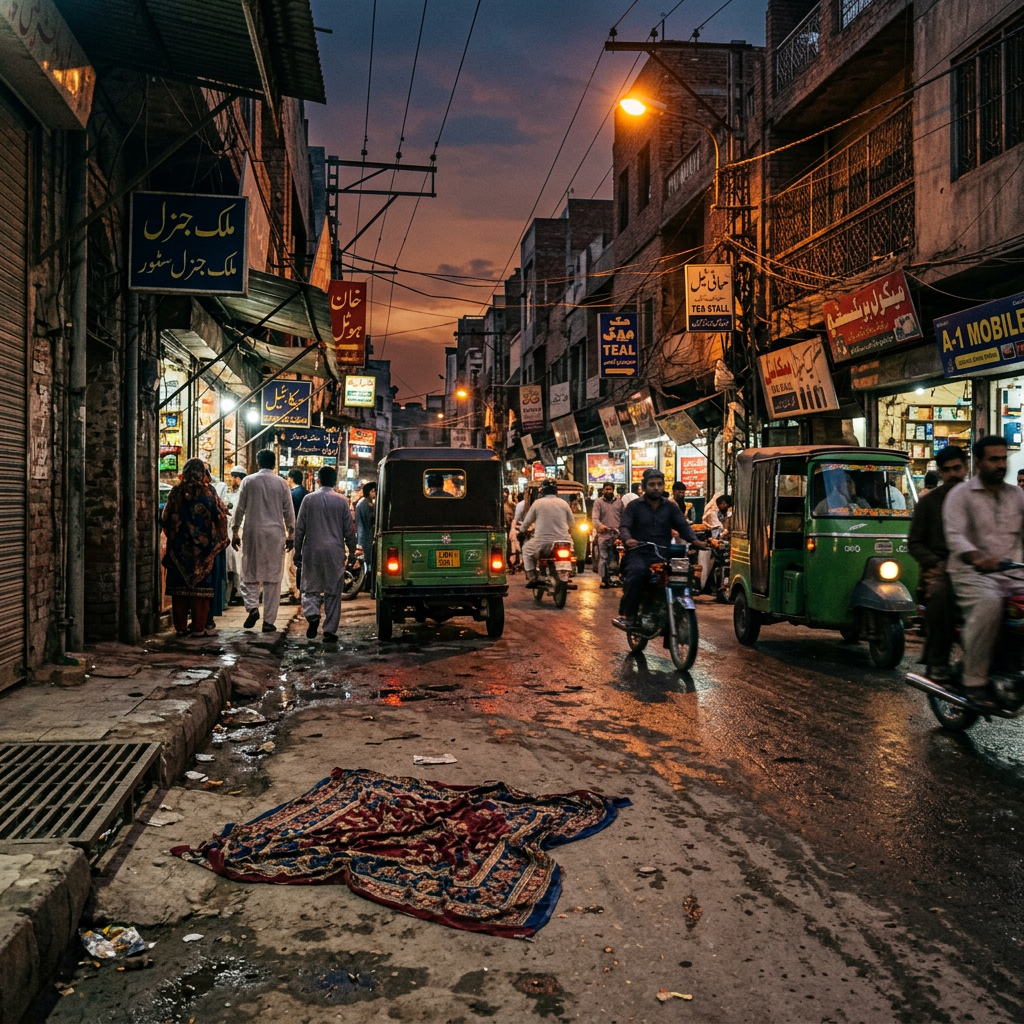
A number landed in Pakistan’s news cycle this week that deserves far more outrage than it has received: 824. That is the number of missing women in Lahore, Pakistan who were abducted over the past five years and remain completely untraced. Not rumoured. Not alleged. Officially recorded and officially abandoned. According to police records reported by ProPakistani, these abductions took place between 2021 and 2025. Despite all cases being formally registered, law enforcement has been unable to determine the whereabouts of a single one of these women.
The FIR was filed. The crime was acknowledged. And then nothing.
In twenty years of observing Pakistani law enforcement, I have watched FIRs serve more as bureaucratic receipts than investigative triggers. A case number is assigned. A file is opened. And in the overwhelming majority of cases involving women, that file quietly closes itself through cancellation, through voluntary court statements, or through the slow bureaucratic death of inaction. What happened to these 824 women is not an anomaly. It is the system working exactly as it has always worked.
The Geography of Missing Women in Lahore
This crisis is not happening in Lahore’s forgotten peripheries. According to ProPakistani, the highest number of unresolved cases comes from Cantt Division, where 282 abducted women remain missing. Saddar Division reported 152 untraced cases, City Division 124, Model Town 110, Iqbal Town 100, and Civil Lines Division 56.
These are Lahore’s most urbanized, most policed, and most camera-surveilled divisions. Cantt Division alone accounts for more than a third of all untraced missing women in Lahore. These are neighbourhoods where a car parked in the wrong place gets noticed. Where CCTV cameras line every major road. Where the state’s physical presence is at its heaviest.
And yet 282 women vanished there without a trace.
If the state cannot find missing women in its most privileged and most monitored areas, the question is no longer one of capacity. It is one of will.
The Courts Speak But Nobody Listens
The Lahore High Court has not been silent on Pakistan’s missing women crisis. According to the Associated Press of Pakistan, Chief Justice Aalia Neelum, while hearing a petition filed by Salma Bibi regarding the recovery of her daughter Muqaddas Bibi, voiced open dissatisfaction over the police report. She stated that the primary responsibility of the police is to recover abducted girls but that the institution appears to be failing in fulfilling this duty.
When a Chief Justice has to publicly shame the Inspector General of Punjab Police in open court, it signals a system that has normalised its own failure. Courts can observe, rebuke, and demand reports. What they cannot do is investigate. That vacuum between judicial concern and police accountability is precisely where 824 missing women in Lahore have disappeared permanently.
I have followed Pakistani judicial proceedings on social issues for years. What strikes me most is not the rebuke itself. It is that such rebukes have been delivered before, on similar issues, to similar officers, with similarly zero consequences. The LHC speaks. The IG Punjab nods. The women remain missing.
The Consent Fiction Behind Pakistan’s Women Abduction Cases
Here is where the story of women abduction in Pakistan becomes more disturbing and more politically convenient.
According to IANS citing rights body VOPM, in nearly 77 percent of cases across Punjab, approximately 80,000 women appeared before courts stating they had left home voluntarily, often for marriage. Legally, such statements were recorded as consent. However, VOPM noted that such statements are often shaped by social pressure, family expectations, fear, and limited choices, raising serious questions about whether they reflect genuine freedom.
Pakistan has quietly perfected a legal escape hatch. A frightened woman appears before a magistrate, says the words required of her, and the case is closed. The FIR is cancelled. The family is sent home with silence. The perpetrators dissolve back into the system.
The Dua Zehra case is the most documented example. She told a Lahore magistrate she had left her home of her own free will and claimed to be 18 years old, yet a medical examination subsequently determined her age to be between 16 and 17. The consent was on record. The reality was something else entirely.
If this happened in a case that received wall-to-wall national media coverage, with lawyers, courts, and two provincial governments involved, imagine what happens in the 824 cases nobody is covering. Imagine what a frightened 16-year-old says to a magistrate when there are no cameras outside the courtroom.
Punjab’s Hidden Crisis of Untraced Women in Pakistan
The Lahore figure of 824 missing women is alarming enough. But it sits inside a provincial catastrophe that few want to name directly.
According to Aaj English TV, over 105,000 cases of alleged abduction of women were reported across Punjab between 2021 and 2025. Of these, 80,767 were later cancelled. Police recovered only 612 women, while 3,258 remain missing across the province.
Read that again. 105,000 cases. 612 recoveries. That is a recovery rate of less than one percent.
Rights organisations have warned, per IANS, that even as thousands of cases are formally closed, the human impact persists. Some 3,864 cases remain under active investigation, 1,432 involving identified suspects remain unresolved, and 1,820 were delayed due to legal or procedural challenges.
Over 100,000 women abduction cases in Pakistan in five years in one province. That is not a crime statistic. That is a policy failure of generational proportions. And it is happening in plain sight, with full official documentation, while parliament discusses other things.
The Questions Nobody in Power Is Asking About Missing Women in Pakistan
Where is the parliamentary committee investigating these 824 Lahore cases? Which police officers have faced disciplinary action despite a Chief Justice’s public rebuke? Is there a dedicated missing women commission in Pakistan, the kind that India’s Supreme Court recently ordered its government to establish through a national tracing portal?
And critically, what are Sindh’s numbers?
As someone based in Karachi, this question is not academic to me. The women of Lyari, Orangi, and Malir are no less Pakistani than the women of Model Town and Cantt. Are we compiling their data? Are Sindh police submitting five-year reports to the Sindh High Court? Are the families of missing women in Karachi’s working-class neighbourhoods receiving even the inadequate official acknowledgment that Lahore’s families received?
The silence from both Islamabad and Karachi on these questions is not administrative oversight. According to the Freedom Network Report 2026, independent journalism in Pakistan is being systematically undermined through legal coercion, censorship, and growing physical threats, shaped by a broader systemic framework designed to suppress dissent.
In that environment, 824 missing women in Lahore becomes a two-day story. Filed under crime. Forgotten by the weekend.
What Accountability for Pakistan’s Missing Women Actually Looks Like
Outrage without demand is just noise. Here is what genuine accountability requires.
A dedicated missing women commission with independent oversight, separate from police command structures, with the power to audit FIR cancellations and court consent statements. The Lahore High Court’s concern is welcome but a petition-by-petition approach cannot address 105,000 cases.
Mandatory Sindh data compilation so that the Sindh government is directed by the Sindh High Court to submit a comparable five-year report. Karachi deserves to know what Lahore now knows, however painful those numbers may be.
A Supreme Court suo motu notice on the national pattern of missing women cases across all provinces, not just Punjab, to establish whether this is a law enforcement failure, a trafficking network problem, or a judicial consent mechanism being systematically abused.
These are not radical demands. They are the minimum that 824 families in Lahore and an unknown number across the rest of the country deserve.
Conclusion
Every one of those 824 women had a name. A family waiting by a door. A phone that stopped ringing.
The Pakistani state registered their disappearance. It counted them. It categorised them by division. And then it did nothing.
That is not a failure of law enforcement. That is a statement of priorities. When the state can tell you exactly how many missing women there are in Lahore, Pakistan but cannot tell you where any of them are, it has made its choice.
The only remaining question is whether we as citizens, journalists, legislators, and judges are willing to make a different one.
Sources: ProPakistani | Associated Press of Pakistan | Aaj English TV | IANS | Lahore High Court proceedings, April 2026 | Freedom Network Report 2026
Leave a Reply